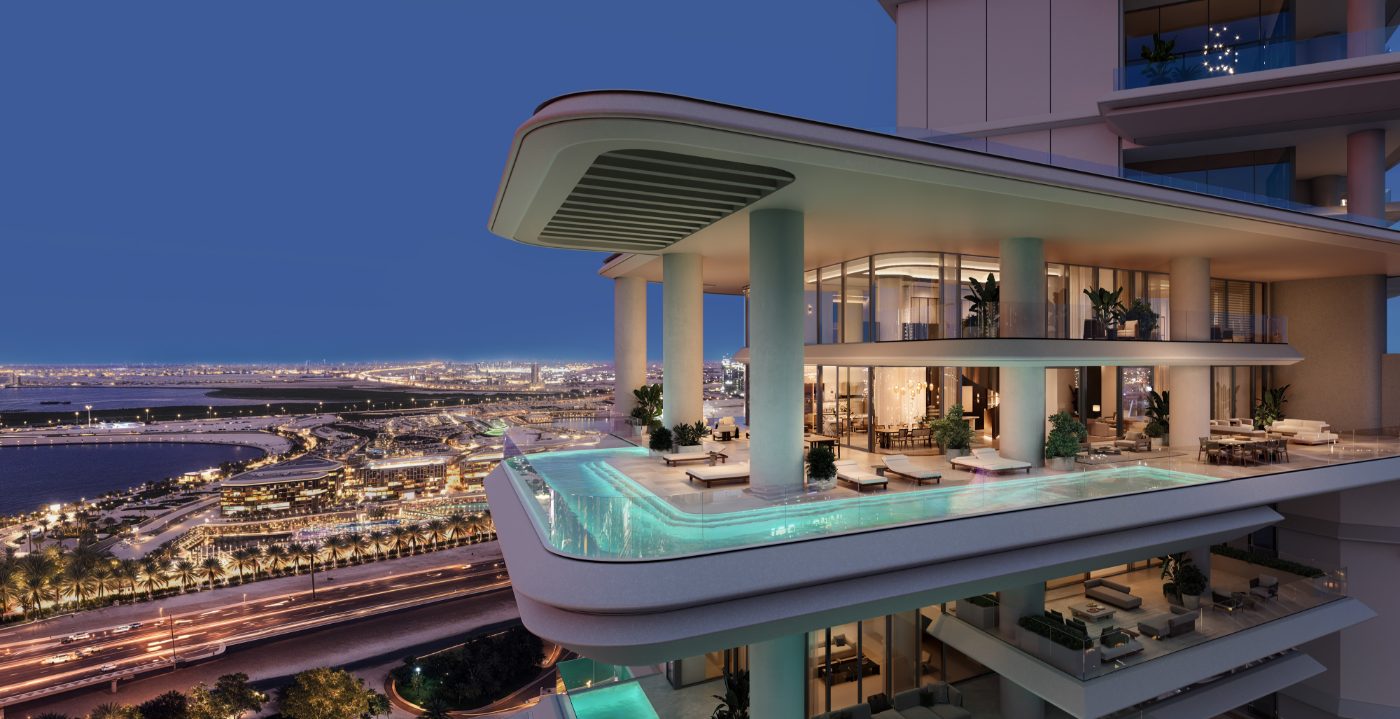
In my last article I followed Savills' map of where the next generation of wealth is choosing to live, from New York and Miami to London, Dubai and the Mediterranean. This piece is about what happens when that generation arrives. What does it buy? Which homes are genuinely scarce? And what does a square foot of the best of Dubai cost compared with the most expensive places in the world?
Savills' own conclusion is a good place to start. As wealth moves across borders and generations, it expects capital to become more selective, and it expects the most resilient homes to be those that are scarce, turnkey and highly serviced, in markets that combine legal stability, lifestyle, privacy and long-term liquidity. That is a fair description, almost word for word, of what my younger clients ask me for. Here is how each of those qualities shows up in Dubai's registered data and in its best buildings.
Capital is becoming more selective
One line in the Savills report stays with me. It says residential property is now being judged alongside private markets, technology, hospitality and operating businesses, and that it must do more than preserve capital. It has to support how a family lives, works, travels and plans.
In practice, that means the next generation is less forgiving than its parents. A home that is merely expensive is not enough. It has to be in a position that cannot be replicated, finished to a standard that needs no further work, run by a team that can look after it in the owner's absence, and saleable to the next family when the time comes. Homes that meet all four tests are rare in any city, and Dubai is no exception.
Scarce: the addresses that cannot be repeated
Scarcity is easiest to see where supply cannot grow. Dubai has a handful of such addresses, and the Dubai Land Department figures for the most recent twelve months show how differently each is behaving.
Palm Jumeirah villas. There were 77 villa sales on the island, 30.6% fewer than in the previous year. Over the same period the median villa price rose 33% to AED 44 million, and the median price per sq ft rose 16.7% to AED 7,000. Fewer sales and higher prices at the same time is what limited supply looks like in the data. The fronds are finite, almost no new villas are being built, and owners who do not need to sell tend not to.
Emirates Hills. The pattern is sharper still. There were 25 villa sales, down 37.5%, while the median price rose 25% to AED 65 million and the median price per sq ft rose 36.7% to AED 4,850. Emirates Hills has fewer than 600 villas in total and no new ones are being added. With so few sales, each one moves the median, but the direction is clear.
Dubai Hills Estate. This is a larger, newer community and it behaves differently. There were 165 villa sales, down 35.6%, and the median price rose a more modest 6.3% to AED 14.65 million, at AED 3,060 per sq ft. Dubai Hills still has new supply coming, and that shows in the steadier pricing. It is a good reminder that scarcity is specific to a location, not a feature of a whole city.
Jumeirah Bay. The island recorded the highest median price per sq ft of the four, at AED 8,790, but on only 16 sales, down 44.8%, and the median price fell 18% to AED 22.75 million as the mix of homes sold changed. I include it because it shows the limits of a median when sales are this thin. At this level, the evidence for a specific building or plot matters far more than any area figure.
With fewer than 100 sales a year in most of these places, I read the medians as a direction rather than a precise measure. But the direction in the truly finite addresses has been consistent: fewer homes changing hands, at higher prices.
Turnkey: ready on the day of arrival
A family that lives across two or three countries does not want a year of fit-out. Savills singles out turnkey, highly serviced homes as the ones globally mobile buyers prefer, and JamesEdition's Dubai example in its summary of the report was a fully furnished mansion in Dubai Hills Estate, chosen precisely to illustrate demand for finished trophy homes.
This is also why the realistic alternative to a villa on the Palm is often a large residence in a branded building rather than another villa. Within the Dorchester Collection, VELA is delivered fully fitted and fully furnished, with interiors by Gilles & Boissier. ORLA Infinity is delivered fully fitted with interiors by YODEZEEN, and furniture is available à la carte through OMNIYAT Atelier. For a buyer arriving from London or New York, a home finished to that level on handover is often a closer match to what they are leaving than a villa that still needs work.
Serviced: a home that runs when you are away
The next generation tends to treat a home as one of several bases rather than its only one. Henley & Partners made the same point in its 2026 report, describing families spreading residence, citizenship and business structures across jurisdictions so that no single place holds the whole of their life and capital. A base like that has to work in its owner's absence. It needs a residence team that can open the home, receive deliveries and prepare for an arrival at short notice, security that does not depend on the owner being present, and privacy that is built into the building rather than added later.
Savills also identifies wellness as a growing driver of demand, from health clubs in London to recovery spaces in new developments elsewhere. In Dubai, the buildings that do this well treat the spa, gym and pool as part of daily life rather than a brochure feature, and buyers notice the difference quickly.
A serviced home that is used for part of the year can sometimes be let for the rest. My Rental Index tracks registered rents at One at Palm and The Lana so that clients can see what comparable homes have achieved. Past rents do not guarantee future income, and letting rules and building policies should always be checked first.
What a square foot of prime buys: Dubai against the world
When international clients compare Dubai with the other cities on their list, the conversation often turns to a single number: what a square foot of the best address costs. Savills gives two useful reference points. Monaco is the most expensive prime residential market in the world, at an average of around US$6,135 per sq ft. Hong Kong is the most expensive in Asia Pacific and second only to Monaco globally, at around US$3,750.
Against those figures, at the fixed exchange rate of AED 3.6725 to the dollar, Dubai's scarcest addresses look like this over the most recent twelve months:
Jumeirah Bay at a median of AED 8,790 per sq ft is around US$2,393. Palm Jumeirah villas at AED 7,000 are around US$1,906. Emirates Hills villas at AED 4,850 are around US$1,321. Across all property types on the Palm this year to date, the median is AED 3,550, around US$967, and across Dubai as a whole it is AED 1,716, around US$467.
On those numbers, a Palm villa costs less than a third of Monaco's prime average per square foot and around half of Hong Kong's. Even Jumeirah Bay, the most expensive of Dubai's addresses on this measure, sits well below both.
Why that comparison needs care
I am careful with comparisons like this, for three reasons. First, the measures are different: Savills' figures are averages for prime stock, while mine are medians of every registered sale in a period, some of which are not prime. Second, the products are different: a Palm villa usually comes with far more space, outdoor area and beach frontage than a Monaco apartment at the same budget, so price per square foot understates the difference in what you get. Third, the cost of owning differs between cities, through taxes, service charges and running costs, and over a long hold that matters as much as the purchase price.
Nor does a lower price per square foot mean Dubai will close the gap. Cities are not obliged to converge, and I never present a lower entry price as a promise of growth. What the gap does show is that, for a family choosing between global addresses, Dubai offers a great deal of space, service and position for the money.
The longer history is worth knowing all the same. In 2014 the Palm's median was AED 1,740 per sq ft; this year to date it is AED 3,550. Past performance is not a guide to the future, but it shows how the market has treated the addresses that cannot be replicated.
Liquid: thinking about the next buyer
The last of Savills' tests is the one buyers mention least and should weigh most. A home that is scarce, finished and serviced is also the home the next family will want, which is what makes the decision reversible.
It also means reading the market carefully. On the Palm, developer sales over the last twelve months were recorded at a median of AED 5,700 per sq ft against AED 2,930 for resales, a gap that reflects how much of the new supply is ultra-prime and branded rather than any discount on a single home. I set out what that means for buyers in my piece on resale or off-plan on the Palm.
The best homes at this level rarely reach the open market, and asking prices can run ahead of the registered evidence. I price from registered sales, not from listings, and I encourage every buyer to do the same.
How I approach it with clients
When a family from this new generation asks me where to start, I work through the same four tests Savills sets out, in the same order. Is the position genuinely scarce, or simply expensive? Is the home finished to the standard the family expects, or is it a project? Can the building look after it when no one is there? And who is the next buyer likely to be? A residence that passes all four is worth moving quickly for, because at this level the right homes are usually agreed within days, often before they are advertised.
If you would like to see the registered evidence for a particular address, building or line of residences, set against the other cities on your list, send me a private enquiry.
Sources: Savills, Spotlight on Wealth Trends 2026, October 2026 (Monaco and Hong Kong average prime prices per sq ft, conclusions on resilience, turnkey and wellness), as summarised by JamesEdition, 28 October 2026; Henley Private Wealth Migration Report 2026, 16 June 2026. Dubai figures: Dubai Land Department registered sales, aggregated via DXB Interact, data as of 27–30 October 2026. Area figures are trailing-twelve-month medians with year-on-year change unless stated as year to date. US dollar conversions at AED 3.6725. Medians reflect the mix of homes sold and are not a valuation. Delivery specifications as published by OMNIYAT. This is general information, not financial advice.